



DSD radar speed display
DSD speed displays offer maximum durability and visibility to actively contribute to speed reduction in cities, municipalities, and towns. State of the art sensor technology responds from speeds as low as 3 km/h, making them suitable even for pedestrian zones.
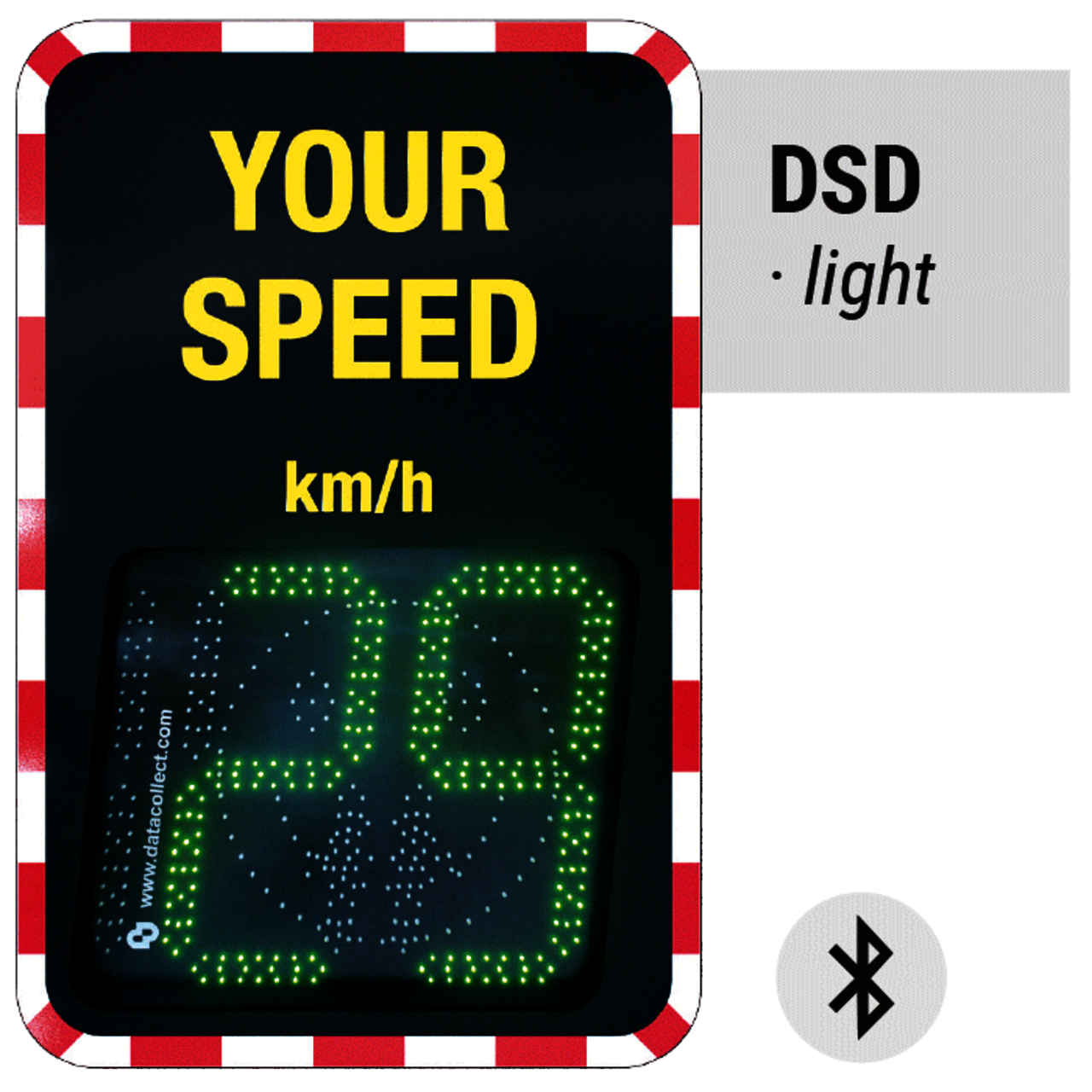
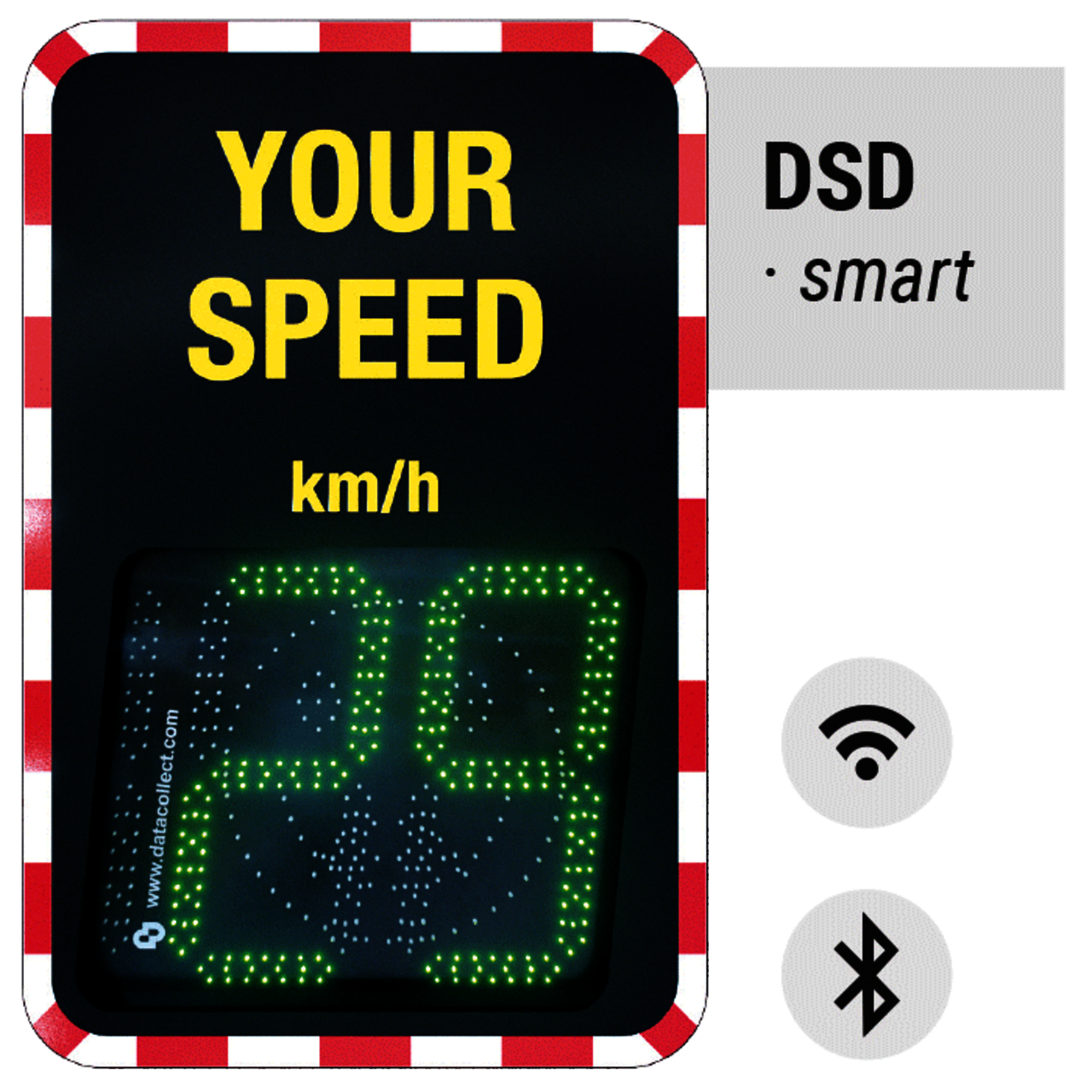
Choose from three DSD models and benefit from numerous customisation options!

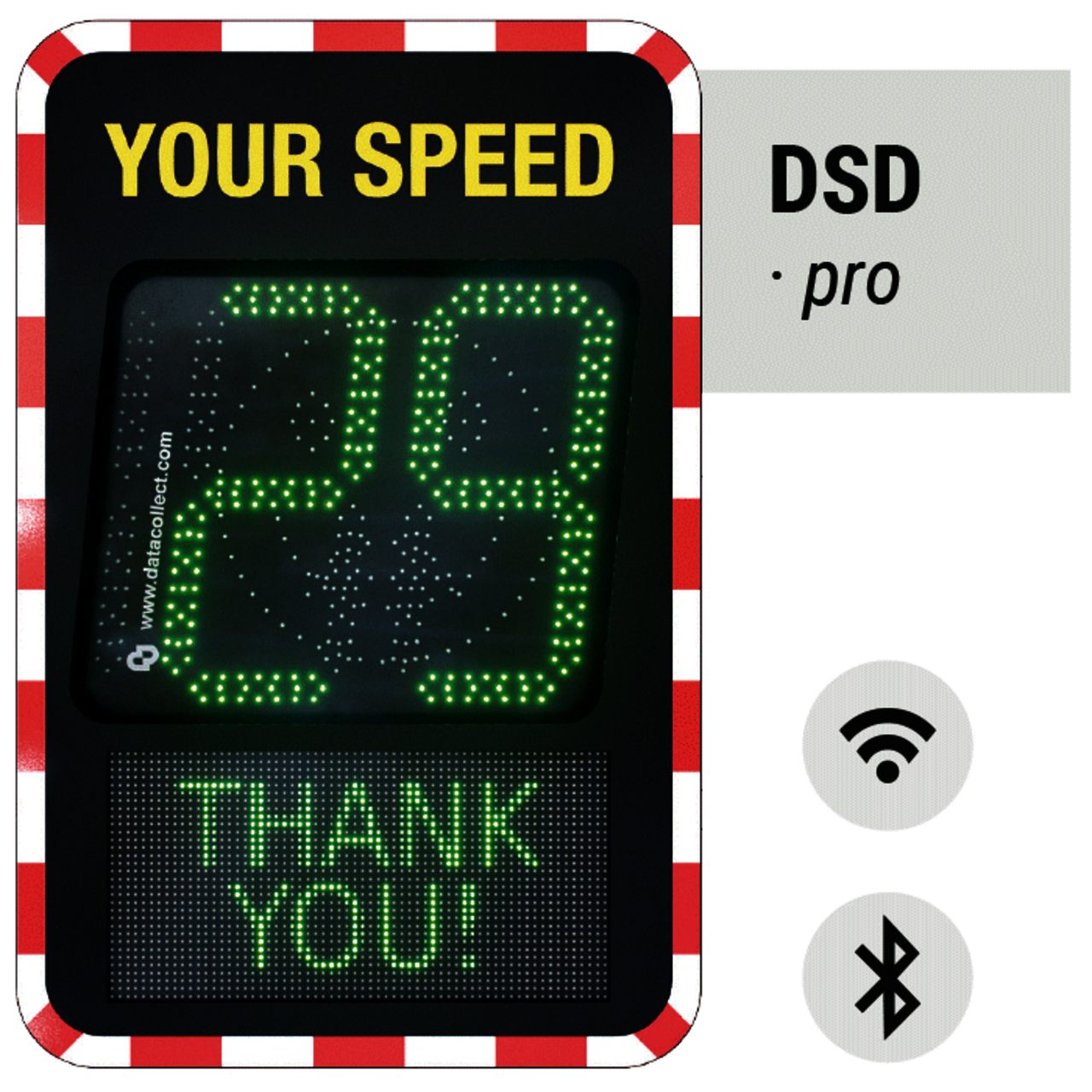
| Display technology | High output LED (monochrome), tricolour LED (red, amber, green) optional |
| Flex-Display | one-line or two-line LED-text |
| Sensor type | Microwave |
| Frequency | Typ. 24,125 GHz |
| Output power | 5 mW |
| Radar range | Min. 80 m; typ. 100 m; max. 120 m (passenger car) min 260 ft; typ. 330 ft.; max. 395 ft (passenger car) |
| Speed display range | 3 - 199 km/h or 2 - 125 mph |
| Speed measuring range | 3 - 255 km/h or 2 - 158 mph |
| Resolution | 1 km/h or 1 mph |
| Units | Metrical or Imperial |
| Memory | 512 kB (RAM buffered) |
| Data format | V entry, V exit (optional), date, time (PVR) |
| Data rate | Up to 115200 baud |
| Communication | Bluetooth® or 4G/LTE |
| Monitoring | Online mode via smartphone/tablet |
| Setting | Android smartphone/tablet |
| Installation angle | Horizontal 0 - 5°; vertical 0° |
| Ambient temperature | - 20 °C - + 50 °C / - 4 °F - + 122 °F |
| Weight | DSD light/smart 6,0 kg / DSD pro 7,5 kg DSD light/smart 13,2 lb DSD pro 16,5 lb |
| Dimensions (WxHxD) | 527 x 806 x 51 mm / 1,729 x 2,644 x 0,167 ft |
| Housing material | Luran ASA |
Additional features
| UpdUpdate | Flash Update |
| Webapps | Additional features and functions are available via WebApp Shop and flash update |
Software
| myTrafficData | Web-based application, reporting and data management software |
Energy supply
| AkkuPack | 12 V / 18 Ah rechargeable battery incl. connection cable |
| PowerUnit | 100 - 240 VAC main power supply incl. 12 V / 33 Ah rechargeable battery (night power) |
| Power supply unit | 12 VAC 100 – 240 (permanent power) |
| SolarSystem | 80W / 100W 18Ah / 33 Ah |
Installation
| SmartBracket | Variable pole mounting installation bracket for 40 to 160 mm diameter |
| SmartBracket deep | Variable pole mounting installation bracket will carry a Powerpack or PowerUnit |
Accessories
| Smartphone/tablet | Android smartphone/tablet with Class1 Bluetooth® Module |
| Tripod | Heavy duty steel or lightweight aluminum tripod for short term mobile measurement |
| Locks | Heavy duty steel locks |
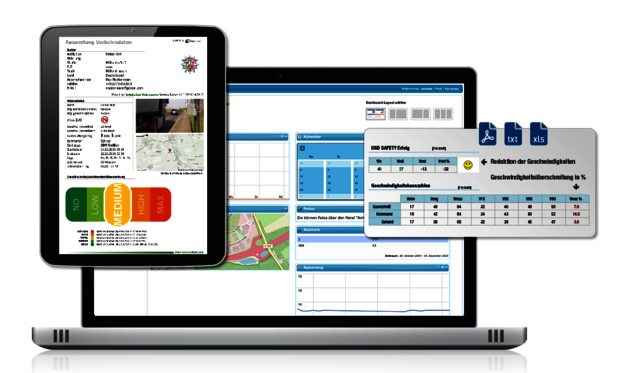
Online Configuration and Monitoring
What is the traffic situation at a given time? How much have speeds reduced? Configure DSD and generate reports on myTrafficData
DSD radar speed display in action


Your questions – Our answers
Definitely, because they address the driver directly and point out an infraction or commend them. Many studies have shown that, above all, feedback in the form of a smiley or a sad face emotionally engages people and leads to a change in behavior. Social pressure also plays a role, especially in the neighborhood. No one wants to be perceived as a speedster by others, as passengers, pedestrians, and cyclists also see and evaluate the driver's behavior.
Speed displays like the DSDs from DataCollect ensure greater traffic safety in their municipalities and cities. They demonstrably reduce speed, which increases traffic safety. Furthermore, they can collect data that can be used to identify hazardous locations. They have a high level of acceptance among the population because they provide friendly reminders and do not immediately penalize every minor offense. However, the data can also provide grounds for setting up speed cameras.
We offer a police report that is primarily used by regulatory authorities in the USA, Canada, Germany, Switzerland, and Austria to assess hazardous locations and the potential deployment of speed cameras.
Absolutely. Speeding is still the most common cause of accidents.(https://www.destatis.de/DE/Themen/Gesellschaft-Umwelt/Verkehrsunfaelle/_inhalt.html) The economic costs amounted to 34.28 billion euros in 2018 (https://bvst-berlin.de/), according to calculations by the Federal Office for Road Traffic. Accidents are the main cause of the sharply increased insurance premiums and affect all drivers.
The first speed display signs appeared in the 1980s. However, they were not very widespread, partly because they were very expensive and only displayed the current speed. In 1993, Christof Herrlich, the founder of DataCollect, had the idea of giving drivers feedback:
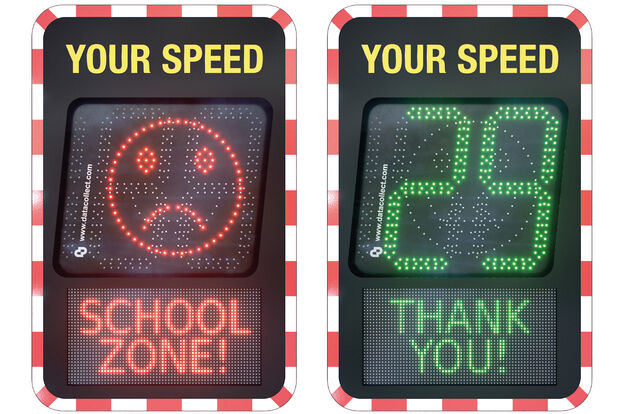
A smiling smiley face when adhering to the speed limit and a frowning smiley face when exceeding the speed limit. This feedback feature led to widespread success for the product, and it has since helped to reduce speeds, especially at critical points, and also to record them.
DataCollect is the inventor of the smiley face on speed displays. The trademark for the smiley face is registered with the European Patent Office for DataCollect Traffic Systems GmbH.
This variant has proven itself. It attracts more attention, is eye-catching, and varied. The smiley is very popular in society, and studies have shown that people want to be smiled at. That's why they reduce their speed.
The company DataCollect is considered the inventor of the smiley on speed displays. The trademark for the smiley is registered with the European Patent Office for DataCollect Traffic Systems GmbH.
They differ in the size of the digits, which determines how visibility at a distance and thus their readability are.
Basically, the further the detection range, which can extend up to 200 meters, the longer the driver has to reduce their speed.
Some speed displays show the speed exclusively in numbers, some only as text, or a combination of both. Studies have shown that displaying the speed and providing feedback, such as a smiley face, are the most effective.
Tests in Great Britain have shown that feedback on behavior with a smiley is more effective than one with text. The testers attributed this to the fact that the smiley is processed more quickly. In general, images are more common in the area of "warning" or "indicating" than texts. An example is the sign for escape routes. It is immediately understood. One explicitly forgoes a text here. Nevertheless, texts have a supportive effect. The study found that they do not lead to a further reduction in speed compared to just using the smiley. But nice texts like "fits" or "doesn't fit" additionally appeal to people.
If a speed display is on a straight road that is neither downhill nor uphill, it measures with an accuracy of 1 km/h. If the road is downhill or uphill, a correction factor can be set so that road users are shown the correct speed. That ensures acceptance.
Most systems measure from 7 km/h. Some manufacturers, like DataCollect, can measure from 3 km/h. The recording is then useful if you want to use the systems in encounter zones or traffic-calmed zones.
The systems from DataCollect are very quick and easy to install in 15 minutes by one person with a ladder, without any specialized personnel. Only for variants with mains power is an electrician required.
All parts for assembly are included in the delivery.
There, where frequent speed violations are observed. This can be determined thru an analysis with an SDR side radar in advance, or thru observation. In practice, they are often deployed at town entrances and then at all locations where adherence to speed limits is a high priority. For example, on roads near kindergartens, schools, residential areas, and senior residences. So, everyplace where it can be assumed that, especially weaker road users, may not be able to react in time to vehicles traveling at high speeds.
The optimal solution is a mix of mobile and fixed systems, depending on the location and function. Fixed systems are suitable for sensitive locations such as kindergartens, schools, or the transition from a country road into a town entrance. Mobile systems as a complement for flexibility and citizen concerns.
The market leader in radar speed displays in Germany, Austria and Switzerland is the company DataCollect.
Yes. The easiest way to set it up is via an app. But also via the cloud over LTE. The new apps, for example from DataCollect, are intuitive to use. Whether a beginner or a professional, it is very easy. With a few clicks, the system is set up.
No, you are not allowed to simply hang signboards in public spaces. This requires permission from the municipality or city. In general, citizens' initiatives are formed to apply for this at the city, and these are always approved. Of course, any citizen can contact their municipality or city to make suggestions about traffic safety.
The speed displays from DataCollect record the number of vehicles, date and time, as well as the entry speed and exit speed, so that it can be traced that drivers adjust their speed. So a success check.
Not really. The systems record the number of vehicles that have driven up to the board. Due to the alignment of the radar, the vehicle with the largest front is always detected. A good example is a truck. If a truck drives up to the display and a car is behind it, the car will not be detected because most of the time the truck is being seen. Classification is also not possible, as the measuring unit, that is, the radar, is perpendicular to the objects. However, the speed measurement is very accurate. There are suitable traffic counting systems for traffic counting.
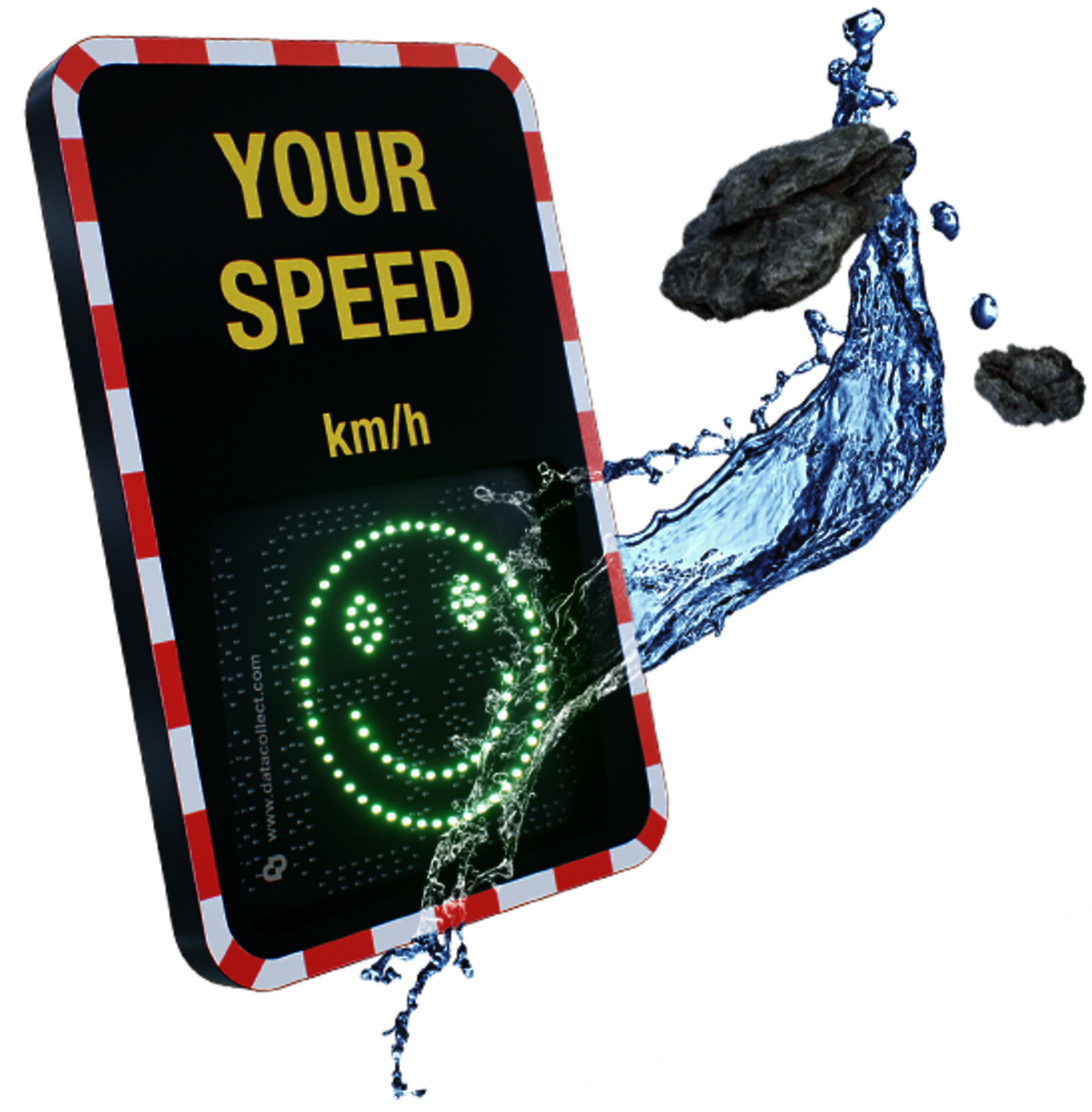
Our display boards are very robust as well as temperature- and weather-resistant. The materials used ensure special durability and impact resistance.
You will find speed displays from us on the market that are over 10 years old, some even 15 years old. Currently, we are in the 7th generation. In each generation, we have incorporated experiences from the previous generation to improve handling and service life.
Yes, that is shown once by the feedback from our customers. As an example, here is a report from Wesseling, who have been a customer of datacollect since 2008 and repeatedly acquire new systems. https://www.wesseling.de/rathaus-politik/presse/2008/106150100000019264.php
Often it is not intentional that road users drive too fast. The friendly reminder leads to a change in speed. Our braking distance calculator shows you the effect of speed reductions on the braking distance. https://www.datacollect.com/en/road-safety/protect-life-how-it-works/
A speed display can be powered by battery, solar energy, or mains electricity. It depends on the place of use. But even with mains electricity, the systems consume very little energy, which costs only a few euros per year.